My blog is reader-supported. When you buy through links on my site, I may earn an affiliate commission.
Author’s note: I’m working on getting back into blogging and I want that to come from a much more honest place. I write about reading, writing, and a bit about history, so this is my first step back into that with a bit of an update on where I’m at. I’ll be posting more about my alt-ac trajectory in the near future. ♥︎
CW: Brief discussions of mental health, burnout, and suicidal thoughts.
A few months ago, writer Molly Priddy tweeted that “your 30s are for unlearning all the conformity you picked up in your teens and 20s and getting back to the weirdo you were as a kid.“ If anything could sum up how I’ve felt about life on the other side of 35, that would be it. It’s been a year, y’all — 2022 has kicked my butt, but in the best possible way. You see, I’ve spent most of my life feeling like an outsider, the wallflower, the kid on the sidelines. I don’t say that to elicit pity; it’s simply how I’ve always felt. Not quite on the same path as everyone else. I’ve been pretty open with people about the effect that doing a PhD had on my mental health, how that led to being diagnosed with PTSD on top of other chronic illnesses, and how the academic world has never felt like the genuine place for me. But that’s all a story for another day (and yes, I always, always recommend therapy — it has literally saved my life). Today, I’m thinking about that weird little girl I used to be and how I’m making space for her once again.
When I was growing up I loved learning new things. I kept a crazy amount of stuff up in my little noggin. I had this wonderful book of North American Mammals that I read over and over, to the point the pages were nearly falling out. I loved going to the North Carolina Zoo and one of our family friends was a marine biologist. I had books on insects and plants. I was obsessed with owls and books about wildlife. Most of my favorite children’s novels had some sort of survivalist element too (Hatchet, of course, and My Side of the Mountain for example). I channeled a lot of this into the experience of being homeschooled later on — in reality I was an autodidact — trying to learn what I needed in order to make it to college. As I got older, I certainly still had hobbies that were outside the norm for teens my age and undergrads, too. I mean, the average twenty-year-old woman isn’t refinishing antique furniture, right? Even if it was before Facebook and other forms of social media dominated our lives.
My twenties were all about trying to be as “normal” as possible. I shrunk the parts of myself that seemed “too much” and tried to measure up to what I thought others expected of me — the outgoing primary school kid who’d been in the “gifted” classes, the grad student burning the candle at both ends, the woman trying to pursue a life dictated by a history of childhood trauma that constricted a lot of what she thought life and love could be. When I finished my doctoral studies and moved back to the US, I did what was expected of me. I got a job in my field teaching history (albeit non-tenure track and non-research-supporting) and started trying to turn my thesis into a publishable book. It’s been five years. I’ve nearly broken, several times, as the burnout and identity crises built up. The summer of 2021 was the worst point, when I finally had to let people in and get better support. I was ready to bring it all to an end. Then I embarked on a long process of healing that’s not nearly over. It did, however, push me to peel back a lot of layers to see that the weird little girl I used to be was okay and she was welcome, she could explore again. I took to the woods and spent a few days camping late that summer, unplugging so that I could reconnect with the sound of birds and the wind in the leaves of birches and elms. Even the fireflies came out.
Somewhere in between all of that, I stumbled upon the work of some of my favorite filmmakers and actors that then led me to an odd little podcast called The Cryptid Factor — a show dedicated to the world of cryptozoology and the weird. Hosts Rhys Darby, Dan Schreiber, and Leon “Buttons” Kirkbeck relay their findings of the week’s out-there headlines with a heavy dash of comedy. Listening to them talk about everything from the plausibility of the Loch Ness monster and the latest Sasquatch sightings to wacky science experiments and space travel has become the little boost of serotonin that I’ve needed on otherwise difficult days. Last month, Schreiber released his first book, The Theory of Everything Else, that digs into why we as humans get into such “weird” ideas. It’s fun and engaging read that will leave you laughing and scratching your head at all the odd ideas we as humans have come up with. I don’t typically read science-adjacent works (she says, staring at her shelf of environmental history books and nature writing), but I’m so happy that I’ve been exploring these more often. Eight-year-old me would be very happy.
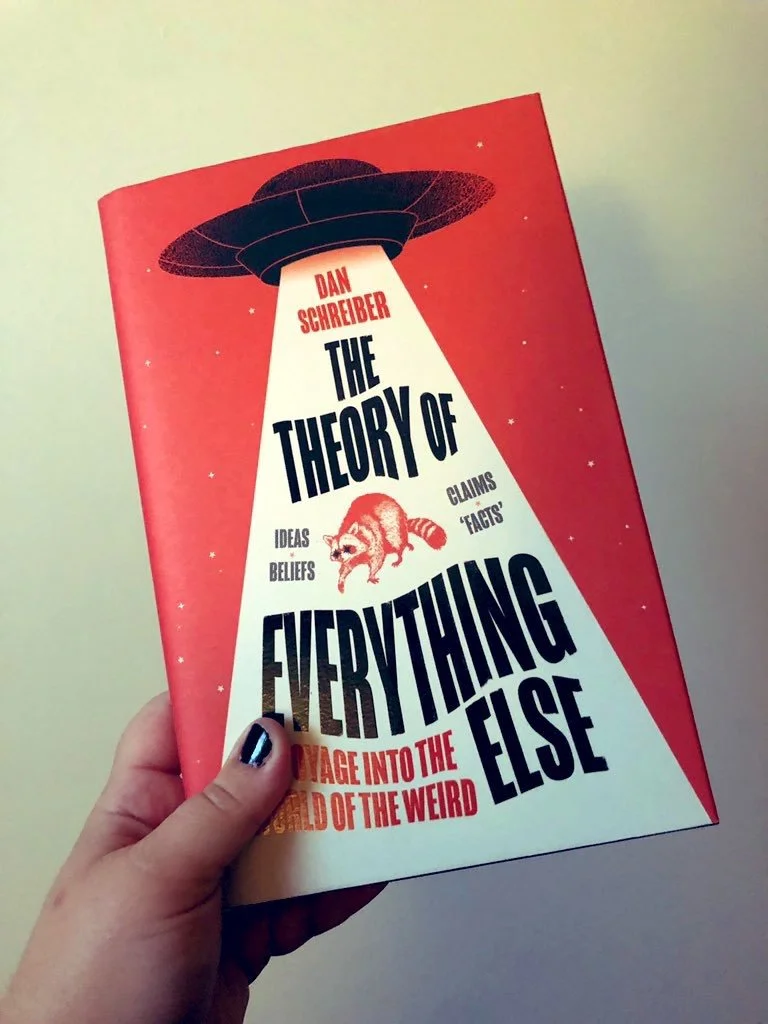
Life is strange, and you never quite know how it's going to play out nor where your big adventure may take place. . . . Most people live their lives trying to manufacture the next move and putting themselves in the right place at the right time. But that's too safe, too predictable. Life is more exciting than that -- put yourself in the wrong place at the right time and magical things can happen.
— Dan Schreiber, The Theory of Everything Else
In The Theory of Everything Else, Schreiber talks about the Zen gardening practice of leaving a “rough corner” in one’s carefully manicured garden as a reminder to the wildness that nature and the universe intended. “I believe we should all be cultivating a healthy Rough Corner in our minds,” he writes. “A small nook in the back of the brain that ensures we never fail to get goosebumps when we’re told a mad-as-hell idea, no matter how batshit it may be.” After all, “great things have been achieved by those who believe in weird ideas.” You’ll see what that means when you hear about attempts to interrogate plants, the secret UFO files of the late Prince Philip, or how one of the most important scientific books accidentally promoted the idea of a hollow earth. It was a delight to read.
I’m still processing a lot, but I’m learning to embrace the weirdness of being me. Happy to be on the outskirts a bit, happy to stay curious. It keeps things interesting, at least.
***
If you’re in the US, you can preorder Dan’s book before it’s release in June 2023. It’s available currently in the UK/Aus/AoNZ.
*Yes, the title of this entry is from one of my favorite weird little films, Stanley Kubrick’s Dr. Strangelove, or How I Learned to Stop Worrying and Love the Bomb.