This holiday season has felt incredibly different for a variety of reasons. Some, I suspect, are from getting older. Others are a bit more complicated. It’s forced me to think about the things that I value most, what brings me the most joy around these days that are charged with expectations and obligations. It certainly hasn’t been easy.
When the winter solstice came round last week, I was thinking a bit about the historical celebrations of Yule — how it and other holidays of this time of year from various religious traditions celebrate light or the return of the light. On the shortest day of the year, it feels so foreign to think of long summer days when the light doesn’t fade until late into the evening. When I lived in Scotland our winter days were six hours long at best, though gray skies often obscured what sunshine might emerge. It’s not so extreme here in North Carolina, but there is a marked difference as the seasons change from late summer into autumn and on into December.
We are conditioned to fear the dark. We crave the light and the way it illuminates and drives out the things that might scare or worry us. But hear me out — the darkness is important too. We all experience times in life that feel like winter, when things lie dormant and covered in shadow. Parts of this year felt like an extended winter to me, times when everything falls silent. Katherine May wrote about this in her book, Wintering, “We have seasons when we flourish and seasons when the leaves fall from us, revealing our bare bones. Given time, they grow again.” It’s a beautiful look at the fallow times of life when it seems as if nothing is happening, but down deep there are still things moving, growing, readying themselves for a new season.
When I was little, my family would drive about thirty minutes northwest into the sandy pine barrens that line Black River, a dark, tannin-stained tributary of the Cape Fear to celebrate Thanksgiving. There, my grandparents had built a small cottage that served as a getaway from town — the Country House. The little olive-green house with dark green trim sat on a sandy hill, surrounded by cotton fields and pine trees, black jack oaks and formosa azaleas. This is the land where my ancestors eked out a living as farmers, brick makers, riverboat captains, and lumber-yard workers. On these chilly November days my dad would get an early start with his gas-powered pig cooker, a whole hog from Wells, the local butcher, splayed across the grill. It was a slow process, involving a careful watch on temperatures and regular applications of traditional vinegar-based eastern North Carolina barbecue sauce sopped onto the meat. If we were lucky, fresh sausage was also placed on the cooker for a breakfast treat.

The Country House not long after it was built. On the opposite side of the photograph, my grandmother wrote: “This was taken before Harvey put banasters [sic] or blinds. It looks even better now. It’s a light olive trimmed in real dark green. I have shrubs out now too.”
As the day wore on, extended family members would gather and bring a variety of side dishes and desserts. Dad would pull the pork and chop it, dowsing it in more of the tangy spiced sauce. We fought over the belly meat, the coveted long strips of rich, sweet bacon from the underside of the pig. The day often ended around a bonfire, our own bellies full.
At some point during the day, as we grew restless waiting for our elders to announce it was time to say grace and dig in, myself and my younger cousins might be accompanied by our parents for a walk into the woods. We’d follow open paths made by hunters and others to an old cemetery where some of our forefathers and foremothers were buried. Many of the old graves, having been marked simply with a wooden plank, were indistinguishable from the sandy ground around them. A few were easier to spot. On the way back to the Country House, we might get the opportunity to collect a small deciduous tree — now devoid of its leaves — that we could take home to decorate for Christmas. We called them haw bushes, but in reality they were hawthorns (Crataegus phaenopyrum) and they were prized for the spines that protruded from their branches.
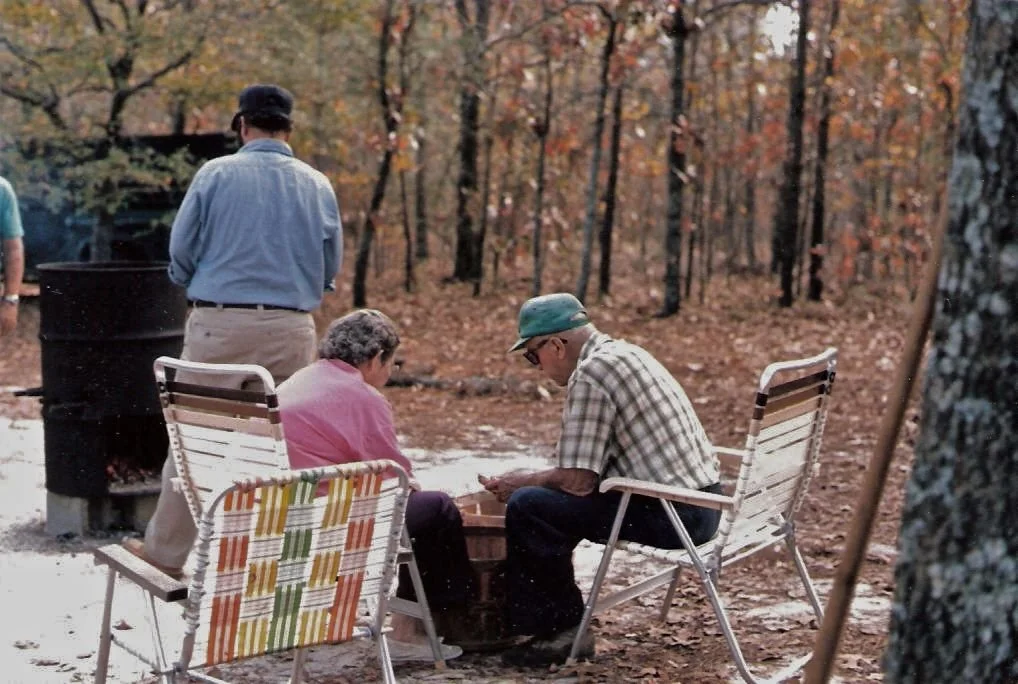
My grandparents, Mamie and Harvey Sherman, probably cracking pecans in the backyard of the Country House while my dad stands at the nearby fire barrel.
When we arrived back home, dad would go to the workshop where he and my grandfather ran a small business making surveying stakes out of b-grade lumber. It smelt of pine sawdust and sweat. He’d cut out little square bases with a hole drilled partially in the middle where a nail might stick up and into the main “trunk” of the little bush. At this point it was nothing more than a naked, thorny twig that looked worse than Charlie Brown’s Christmas tree. I placed my little haw(thorn) bush in my room and decorated it with sugar-frosted gumdrops in red and green that were stuck on each of the thorns. A few sore fingers later, it would be joined by paper cutouts of Santa and reindeer, handmade paper ornaments, and snowflakes galore. This seemingly dead thing had brought beauty into the darkness of winter.
“Here is another truth about wintering: you’ll find wisdom in your winter, and once it’s over, it’s your responsibility to pass it on,” continues May. “And in return, it’s our responsibility to listen to those who have wintered before us. It’s an exchange of gifts in which nobody loses out.” In these times of darkness, literal or metaphorical, there is much to be learned. Welcome the light, but don’t be afraid of what happens in the dark.
“To go in the dark with a light is to know the light.
To know the dark, go dark. Go without sight,
and find that the dark, too, blooms and sings,
and is traveled by dark feet and dark wings.”