Historians are a varied lot when it comes to our beliefs in things that go bump in the night. I’ve always been a fan of the spooky and supernatural, but good luck trying to get me to choose between “skeptic” or “believer.” I recently gushed with a friend over our childhood love for the weird stories of Alvin Schwartz’s In a Dark, Dark Room, and I certainly had my fair share of Goosebumps books tucked into my backpack from the school library. Historian Anthony Delaney recently put some of this into words. He reminds us that we as historians are analytical and must stay grounded in our research of the past. We owe that to our subjects and our audience. I wholeheartedly agree. Yet, Delaney goes on to say that the experience of doing history is in itself its own form of haunting:
Nevertheless, history in itself can be quite a haunting act. I've always thought this. It feels very much like sometimes that, you know, we spend ages poring over these letters and there's nothing like it. When you get to the archive, you have these yellowed, crunchy pieces of paper that have been in existence for 300 plus years . . . . And it's amazing sometimes because there's a blot of ink or you see there's like a tear stain or a blood stain or a doodle or whatever it might be and suddenly the past comes rushing to life.
Have I had my own ghostly encounters, given the amount of time I’ve spent in allegedly haunted spaces? Have I communed with the dead? That’s probably a conversation for another day. What I thought I would share on this All Hallow’s Eve is one of the oddest stories I came across while working on by first book manuscript.
While looking for evidence surrounding the formation of Scottish communities in early North Carolina, I spent some time looking at records of the Scottish Society for the Propagation of the Gospel and those of Inverary Presbytery in Scotland. When the first Gaelic Scots arrived from Argyll in 1739 one might assume they brought a Presbyterian minister with them. After all, their congregations were often central to their Highland communities back home. What I found was that the Argyll colonists and their descendants often struggled to get a full-time Presbyterian minister—who was also fluent in Gaelic—sent to them in North Carolina. Petitions to the Inverary Presbytery went unheeded and disagreements over needs abounded. They didn’t have proper leadership for their homegrown churches until the arrival of Hugh McAden around 1755 who came down from Pennsylvania. On 1 February 1756, McAden wrote that he “‘preached to a mixed multitude, some Presbyterians, some church people, some Baptists, and don’t know but some Quakers.’” The backcountry was a mixed lot.
As I read through the biographies of North Carolina’s early Presbyterian ministers, I came across a fiery preacher by the name of Colin Lindsay. Born in Scotland in 1744 to a large, well-to-do family, Lindsay was commissioned to minister in his home country. He sailed for North Carolina in 1792, arriving in Wilmington before traveling inland to take up a ministerial post with the newly-formed Orange Presbytery in North Carolina. Lindsay’s first congregation was the Black River Chapel, located near Ivanhoe in what is now Sampson County. Oddly enough, that’s the same community where many of my own Scottish and French ancestors would have worshipped. Every Sunday he held a sermon on English and another in Gaelic given the still strong presence of Gaelic-speakers in the area.
Lindsay was not without his detractions, however. Many of his actions and temperamental behavior pushed his congregation to the brink. He was accused of violating the Sabbath when he drove a yoke of oxen home on a Sunday that he had purchased the day before. He was loud, outspoken, and intemperate. Lindsay ultimately left Black River for another congregation in Scotland County, but in 1796 the Orange Presbytery charged him with “intoxication, profane swearing, and intention of dueling.” After finding him guilty, the presbytery suspended him until he proved he had shown “sorrow and reformation.” Only two years later Lindsay was suspended again for “drunkenness and conduct unbecoming to an Elder.” This became an unfortunate pattern with incidents again in 1800 and 1801 before finally being deposed from the Presbytery in 1803. This had also been complicated by his opposition to the evangelical Great Revival that was stirring among the Presbyterian churches.
Now, you might be thinking, “Come on, Kim. Get to the point! Where’s the weird stuff??” Essentially, there were some that attributed Lindsay’s foul moods and even fouler actions to his origins — that he was born after his mother had been dead and buried. Lindsay was fond of telling this story himself and it was repeated often enough in the North Carolina communities where he lived and worked that nearly a century after his death it was still being written about in the newspaper.
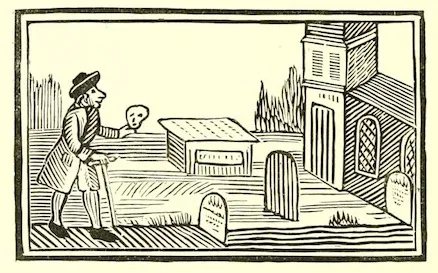
From Chap-books of the Eighteenth Century (1882) in Public Domain Image Archive
Evidently before becoming pregnant with Colin, she “died” and was buried in their community’s burial ground. A funeral and everything had been held! When mourning family members visited the cemetery later that day, they found a pair of men digging up her grave in search of valuable jewelry — they had been a wealthy family, after all. When the pair of thieves attempted to retrieve a ring from Mrs. Lindsay’s finger and it did not budge, they began cutting it off instead. This awakened the poor woman, likely unconscious from a coma, who began screaming and flailing. The thieves took off in terror and Mrs. Lindsay was taken home to recover from the ordeal. Colin and another child were born a few years later. His mother, having been revived in such a way, made her future son into a cantankerous goat. Sounds like another way for men not to take responsibility for their own behavior!
Anyways, it might not be the spookiest story for your Halloween night, but it’s one that stuck with me. Stay spooky, friends!
For further reading:
Malcolm Fowler, Valley of the Scots: A History of the First Scottish Settlers in North Carolina (1986).
Walter H. Conser and Robert J. Cain, Presbyterians in North Carolina: Race, Politics, and Religious Identity in Historical Perspective (2012).
William Henry Foote, “History of the Presbyterians in North Carolina,” (1846).