When I first started writing this post, it was in the upper 90s Fahrenheit again. Coastal North Carolina has been dry as a bone and here in Wilmington we’ve hit over 100º multiple times this month. Add in a bit of humidity and, well, it's pretty oppressive just going out to walk the dog. We finally had a three-day deluge of rain, but the ground seems to have soaked it up entirely—making it feel like there wasn’t any rain at all.
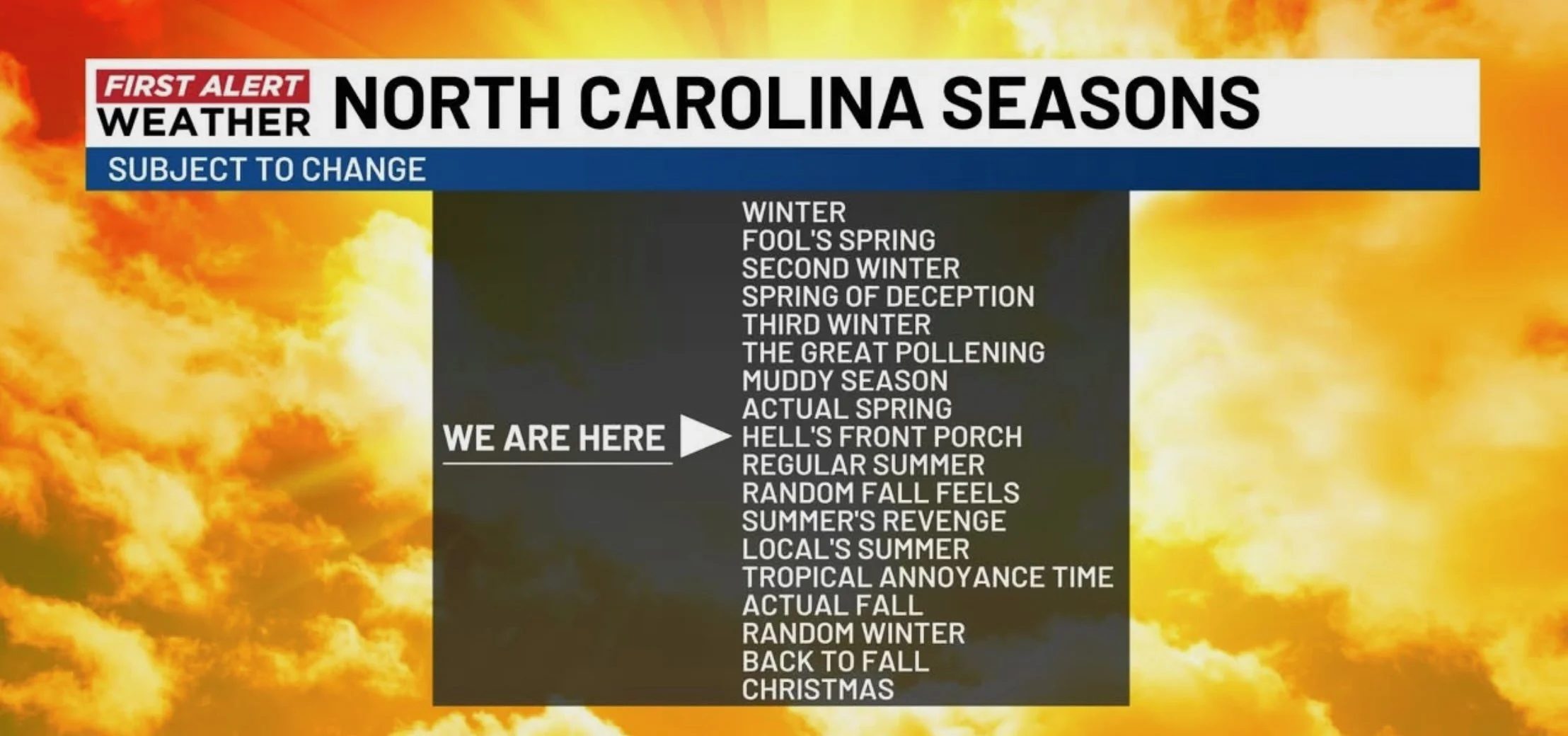
A few years ago, a local weather station created one of my favorite memes (see below) that encapsulates how many of us feel here in the middle of summer: we're on Hell's front porch. Unless you're somewhere cool, it feels a bit like torture. It also reminded me of one quip I heard about why so much of the "Bible Belt" is in the South--with heat and humidity like this it's easy to believe in Hell. As a former Southern Baptist, I can certainly attest to that. 😂
All of this talking about weather had me thinking about some of the people I've written about in early North Carolina. How did they experience weather and climate? One of the sources I thought about was a daily diary kept by a Scottish immigrant in the colony who I wrote about in my PhD dissertation and my first book. William Cathcart, a native of the southwestern town of Genoch, Scotland, moved to Bertie County in 1737. As a graduate of the medical college in Edinburgh, Cathcart intended to work as a “practitioner of physick” in the colony and to set up a plantation where he could profit from agriculture performed by the labor of the enslaved. He served in a few local civil service capacities, but never sought major office, opting instead for growing his medical practice and plantation.[1]
Over the decades of his life in North Carolina, Cathcart kept a journal (or pocket book) where he inscribed notes on daily farming activities, calculations, and—interesting for our conversation here—weather.
A page from William Cathcart’s 1737 journal detailing his arrival in Edenton, NC in December 1737.
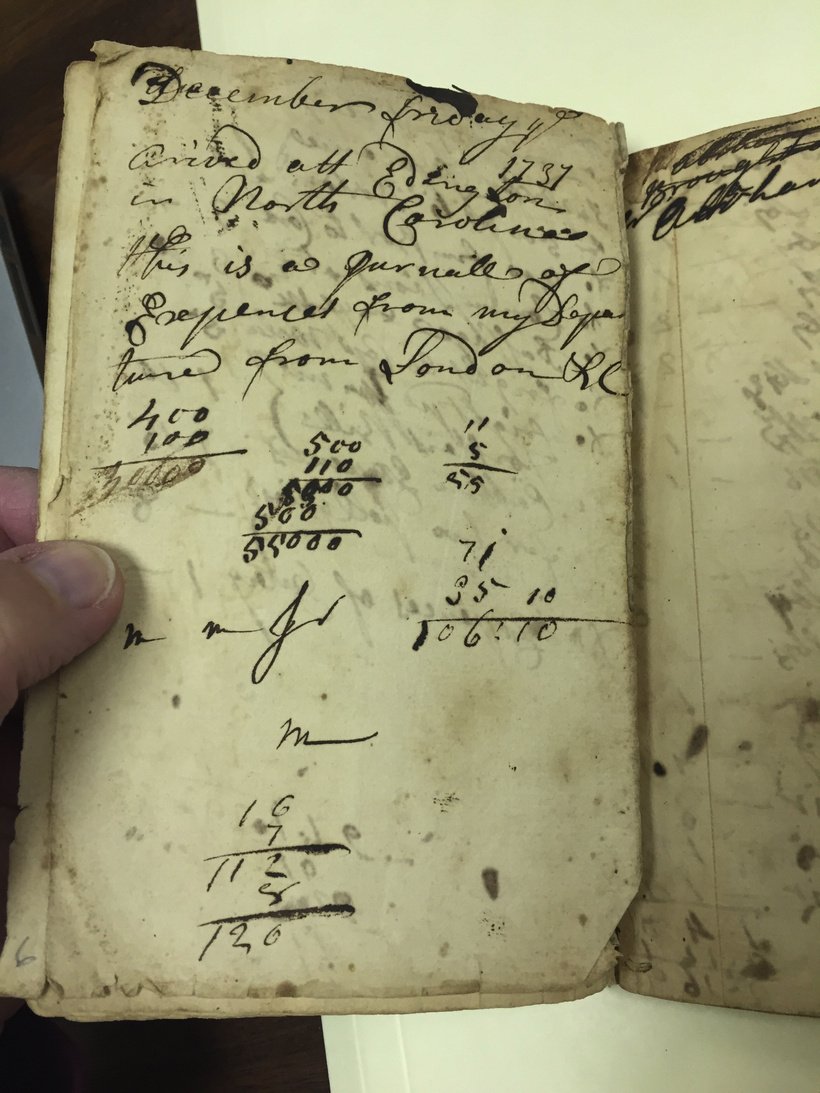
A page from William Cathcart’s 1737 journal detailing his arrival in Edenton, NC in December 1737.
There are nineteen volumes spanning Cathcart’s activities from his arrival in 1737 to a year before his death in 1773. They detail the planting of tobacco, corn, peas, cotton, indigo, and hemp as the seasons turned in northeastern North Carolina. He shipped pine staves, shingles, and planks, as well as cypress lumber out of Edenton, while trading for sugar, salt, rum, molasses, hogs, cottons, sacking, other sundries. He noted the directions he had given to two enslaved laborers, Coco and Manassas, to begin sawing planks of lumber, as well as other plans for expanding his enterprises. [2]
On January 1, 1752, Cathcart reported frost and snow with winds from the north. A barn on the plantation burned, along with its contents of tobacco and corn on the following day when the winds shifted, and the frost and snow continued. In April, he was noting the replanting of his lost crops, but much of the corn was ruined in October when too much rain rotted the year’s harvest. His 1764 his journal included a draft of a letter to his son Gabriel with directions for starting his own plantation, including how much corn to plant, hogs to raise, and how many enslaved laborers to purchase. [3]
The topic of record was not only business and weather, though. Cathcart often noted when he and any of his family had been ill. In 1754 he discussed the difficult pregnancy of his wife Penelope and the dangerous delivery of his oldest daughter Margaret in August. A couple months later, Dr. Cathcart was ailing with a fever himself. [4] North Carolina’s weather could be fickle, but worse so were the dangers of living along some of the swampy, tidal wetlands that make up much of the coastal plain. There, mosquito-borne illnesses like malaria reigned over the “sickly season” of the late summer—roughly August to October—when families like the Cathcarts suffered from what they called “fevers and agues.” Unfortunately, William Cathcart lost both his first and second wives, likely to complications of childbirth and living in such a hostile environment.
A page of William Cathcart's 1754 journal detailing the illness and pregnancy of his wife Penelope
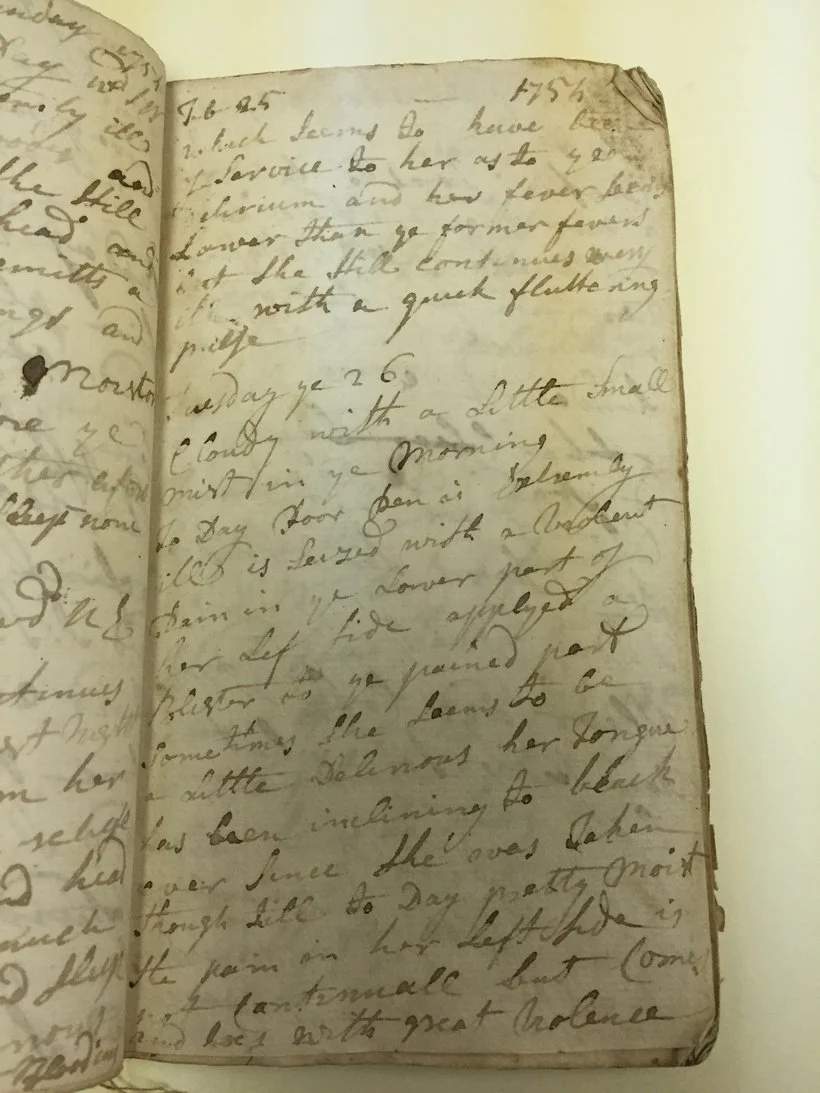
A page of William Cathcart's 1754 journal detailing the illness and pregnancy of his wife Penelope.
William Cathcart’s eldest child, his son Gabriel (named after the royal governor and fellow Scot, Gabriel Johnston), was sent to Scotland as a young man for his education. Family back in Genoch helped ensure that he would be taken care of and supported with the best connections possible. Gabriel studied law at the University of Glasgow and was eventually admitted to the prestigious Middle Temple Society in London before returning to North Carolina for a customs officer post in the colonial government. [5] After getting back to the colony, he wrote to his cousin Robert of what the weather had in store for himself and his family:
"Severall Letters I have wrote you must / if they have not miscarried / before this arrives have informed you of my tedious passage, of my Stepmothers Death which happened a month or two before my Arrivall, & of the low state of heath in which I found my Father, who is now pretty well Recovered; I have myself been seized with the Ague and Fever, & tho’ it has Continued pretty long it has not been very Severe; I find the Climate of this Country does not Agree so well with one as that of Scotld. and that tho a Native of this warm Climate my Constitution is better adapted to one more frigid.” [6]
While Gabriel complained of the “warm climate” in North Carolina versus the cooler one of Scotland (as I can well attest to), the eighteenth-century colony was still much more temperate than that of today. His father regularly recorded average temperatures in July that reached only into the 70s Fahrenheit. Compare that to our 100º+ today! While the North Atlantic was still undergoing what scientists call the "Little Ice Age" at the time, it's pretty clear how global climate patterns have changed over the past three hundred years.
In addition to taking up his customs post at the port of Beaufort & Currituck, Gabriel also hoped to follow in his father’s footsteps, writing, "Probably I shall turn Farmer soon.” Unfortunately for him, Gabriel did not live to see that happen. He died just four years later, no older than twenty. The North Carolina climate with its various fevers and agues put an end to his hopes for a successful future. [7] Luckily today we know more about how illnesses like malaria work and it's no longer endemic here in the US, but there are still many concerns about how climate affects our lives as temperatures become more extreme.
This is just one small part of the story of the families I've been studying and writing about in early North Carolina. They are a fascinating lot, with hopes, dreams, and motivations much like our own. After having read hundreds of their letters, I can easily say that they complained about the weather as much as we do too. The context of their lives is just a bit different.
References
[1] William Cathcart to John Cathcart, June 23, 1737. Cathcart Family Papers, GD180/604/1. National Records of Scotland, Edinburgh, UK; William Cathcart Journal, 1737-1738. Folder 3.68, Volume 3, Hayes Collection #324. Southern Historical Collection, The Wilson Library, University of North Carolina at Chapel Hill; and s.v. “Cathcart, William,” NCpedia.org
[2] William Cathcart Journal, 1752-1753, Folder 3.71, Volume 6, Hayes Collection #324.
[3] William Cathcart Journal, 1752-1753, Folder 3.71, Volume 6, Hayes Collection #324; William Cathcart Journal, 1764, Folder 3.81, Volume 16, Hayes Collection #324.
[4] William Cathcart Journal, 1754. Folder 3.72, Volume 7, Hayes Collection #324.
[5] Gabriel Cathcart Admission Letter to Middle Temple Society, May 14, 1763. Folder 1.49, Box 2, Hayes Collection #324.
[6] Gabriel Cathcart to Robert Cathcart, November 24, 1764. Cathcart Family Papers, GD180/629/1.
[7] William Cathcart to Robert Cathcart, April 22, 1768. Cathcart Family Papers, GD180/625/4.